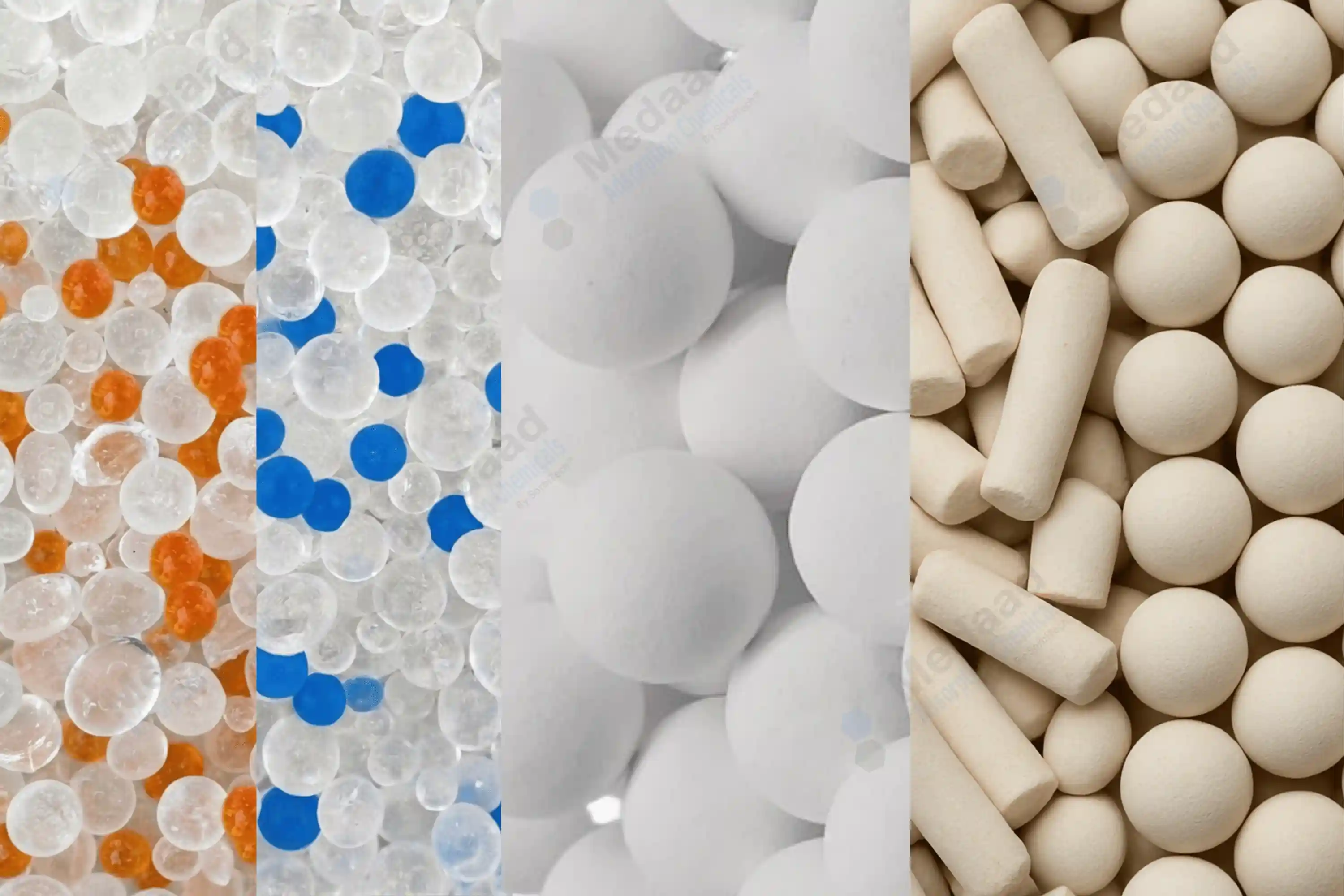
 A desiccant is a solid that dries air or gas by holding water on its internal surface as the stream passes through it. Three are used across most of industry: silica gel, activated alumina and molecular sieve. They can look alike in a drum, but they do not behave the same way. Each has a different pore structure and a different adsorption curve, and those two things decide how dry the outlet gas becomes, how much water the bed holds, and which duties the material suits. This guide sets the three side by side, shows why they differ, and maps where each is used.
| Property | Silica Gel | Activated Alumina | Molecular Sieve |
|---|
| Material | Amorphous silica | Aluminium oxide | Crystalline zeolite |
| Pore structure | Mesopores, 2 to 3 nm | Meso and macropores | Uniform micropores, 3 to 10 angstrom (3A to 13X) |
| Surface area | 600 to 800 m²/g | about 300 m²/g | 600 to 800 m²/g |
| Water held at low humidity | Low | Moderate | High |
| Form and size | Beads, 2 to 5 mm | Beads, 2 to 8 mm | Beads and pellets, 1.6 to 5 mm |
| Dew point reached | −40 to −50°C | −40 to −70°C | Below −70°C, to −100°C |
| Regeneration temperature | 120 to 150°C | 175 to 230°C | 200 to 300°C |
| Contact with liquid water | Can shatter | Withstands it | Kept free of liquid |
Why One Curve Explains the Difference
Silica gel holds the most water when the air is humid, but drops away as it dries. Molecular sieve stays high even at very low humidity, which is what lets it reach a deep dew point.
The chart above is the adsorption isotherm, the amount of water a desiccant holds as the humidity around it changes. It explains the whole comparison. Silica gel and activated alumina both take up a large amount of water when the air is humid, but they give it back as the air dries out, so the lowest dew point they can reach is limited. Molecular sieve is different. Its pores hold water almost as tightly at very low humidity as at high humidity, so its curve stays high and nearly flat. At 100 degrees Celsius and around 1 percent relative humidity it still holds most of its capacity, roughly ten times more than activated alumina and twenty times more than silica gel at the same point. That is why molecular sieve can dry a gas to a very low dew point, while silica gel is the one that holds the most water when the air is wet.
Silica Gel
Silica gel is a form of silica with a very large internal surface area, between 600 and 800 square metres in a single gram, supplied as clear or coloured beads. Of the three it holds the most water when humidity is high, and it is regenerated at the lowest temperature, 120 to 150 degrees Celsius, so it is the cheapest to run. That makes it the natural choice for taking bulk moisture out of humid air and for general dehumidification.
Its weakness is the low humidity end. As the air dries, silica gel releases water quickly, so on its own it cannot reach a very low dew point. It is also brittle, and a slug of liquid water can crack the beads. Silica gel comes in blue indicating, white non indicating and orange forms, held in stock by Medaad as a silica gel desiccant supplier.
It is used across food and pharmaceutical packaging, electronics and instrument protection, HVAC dehumidification, and as the indicating desiccant inside transformer breathers.
Activated Alumina
Activated alumina is a hard, round form of aluminium oxide with a surface area of about 300 square metres per gram. Its strength is toughness. It stands up to higher inlet temperatures and, unlike silica gel, it is not damaged by contact with liquid water, so it is the usual choice inside a compressed air dryer where droplets can carry over. It has a second use as well, taking fluoride and arsenic out of drinking water.
It holds less water than silica gel and needs a higher regeneration temperature, 175 to 230 degrees Celsius. A bed of it lasts through many cycles before an air dryer desiccant replacement is due. Activated alumina serves both as a desiccant and in fluoride and arsenic removal, and is stocked by Medaad as an activated alumina supplier.
Beyond bulk drying, it is used in compressed air and gas dryers, in natural gas dehydration, for fluoride and arsenic removal from water, and as a catalyst bed support.
Molecular Sieve
Molecular sieve is a crystalline zeolite whose pores are all the same size. That size is set by the grade, from 3 angstroms in 3A up to about 10 angstroms in the wider pore 13X, with 4A and 5A in between. Because the opening is fixed, the material grips water tightly even when the air is almost dry, and it can take a gas down to a dew point below minus 70 degrees Celsius, as low as minus 100. The fixed pore size also lets a grade admit water while keeping larger molecules out, which is why molecular sieve is ordered by grade rather than by a single pore number.
It does not hold more water in total than the other two, it costs more, and it needs the hottest regeneration, 200 to 300 degrees Celsius, so it is used where a very low dew point or a clean separation is the point, not for bulk drying. Molecular sieve is supplied in every grade by Medaad as a molecular sieve supplier, with 3A, 4A, 5A and 13X covering the grade range.
It is specified for cryogenic air separation, PSA nitrogen and oxygen generation, ethanol and solvent dehydration, insulated glass units and refrigerant drying.
Silica gel and activated alumina cover general drying; molecular sieve reaches the very low dew points needed for final drying and gas purification.
Selecting Between Them
Start from two questions: how dry the gas needs to be, and what conditions the bed will face.
- If the air is moderately humid and cost matters, silica gel holds the most water for the least running cost.
- If there is compressed air or gas, a risk of liquid carryover, a high inlet temperature, or a contaminant such as fluoride to remove, activated alumina is the durable choice.
- If the gas has to be very dry, or a specific molecule has to be separated, molecular sieve is the one that reaches it.
In many plants the three are layered in a single vessel, with activated alumina at the inlet taking the bulk of the water and a molecular sieve layer behind it polishing the gas to a low dew point. This is how natural gas dehydration and cryogenic air separation are run.
Medaad supplies all three from stock with documentation for every batch, so one supplier can cover the full drying train. Send your stream, flow rate and target dew point for a desiccant and grade recommendation.


