


Nitrogen for Laser Cutting
Manufacturing
ISO 9001:2015
Countries served
40+ worldwide
Experience
10+ years
Documentation
COA, TDS, SDS
Home - Nitrogen for Laser Cutting
Laser cutting of stainless steel and aluminium runs on a steady supply of high purity nitrogen, and that nitrogen is produced onsite by generators packed with carbon molecular sieve. Medaad supplies the Carbon Molecular Sieve at the grade, purity and volume a laser cutting operation needs. The assist gas sets the quality of the finished edge, and high purity nitrogen holds an inert atmosphere at the kerf that prevents oxidation and leaves a clean, bright edge with no secondary finishing.
Nitrogen as the Assist Gas in Laser Cutting
Nitrogen is used as the assist gas in laser cutting because it is inert. It clears the molten metal from the cut and shields the hot edge from oxygen, so the edge does not oxidise. On stainless steel and aluminium, where appearance and corrosion resistance matter, an oxidised edge is not acceptable, and a dependable supply of clean nitrogen is what keeps the cut bright.
A high purity nitrogen stream displaces oxygen from the cutting zone and stops that reaction. The result is a clean, oxide free edge that is ready for welding, painting or assembly without grinding, pickling or deburring. It also avoids the brittle, discoloured edge that comes with oxidised cutting, so the mechanical properties of the material are preserved right up to the cut line.
Nitrogen and Oxygen as Assist Gases
The material and the required finish set the choice of assist gas, not preference. Oxygen is an active gas that reacts with the iron in mild steel and adds energy to the cut, which raises speed on thicker carbon steel but leaves an oxidised edge. Nitrogen works as an inert shield and mechanical ejector, so it needs higher pressure but returns a bright, clean edge on stainless steel, aluminium and other nonferrous alloys.
| Factor | Nitrogen assist gas | Oxygen assist gas |
|---|---|---|
| Cutting action | Inert shielding and mechanical ejection of the melt | Exothermic reaction that burns and adds cutting energy |
| Typical materials | Stainless steel, aluminium, brass, copper, thin mild steel | Thicker mild steel and carbon steel |
| Edge quality | Clean, bright, oxide free, ready for finishing | Oxidised edge that often needs cleaning before finishing |
| Gas pressure | Higher pressure needed to clear the melt | Lower pressure, since the reaction assists the cut |
Oxygen wins on raw speed in thick carbon steel, but the iron oxide it leaves is brittle and can flake, and it usually has to be cleaned back before the edge is welded or coated. For high value work where edge integrity and finish are the priority, the inert behaviour of nitrogen makes it the standard choice, and the speed given up is accepted in return for quality and flexibility.
Nitrogen Purity Requirements for Stainless Steel and Aluminium
Purity governs a successful nitrogen cut. The level needed depends on the material and the thickness, and high purity nitrogen is commonly required in the range of 99.9% to 99.999% for laser cutting. Thin sections can run at the lower end of that range, while thicker material and the brightest stainless steel edges call for the higher end.
Any residual oxygen or moisture in the nitrogen stream can restart oxidation at the kerf. On stainless steel this shows as a yellow or darkened edge and, more seriously, as loss of corrosion resistance where the surface chromium is depleted. On aluminium it shows as a rough, edge heavy with dross that reduces strength and fatigue life along the cut. Sustaining the correct purity keeps the atmosphere at the kerf fully inert and the finish consistent from the first cut of a shift to the last.
A stream that is only slightly below target can still look acceptable while carrying oxidation that causes trouble downstream, such as porosity when the cut edge is later welded. Holding purity is therefore about protecting the whole process, not only the visible edge.
Onsite PSA Nitrogen Generation
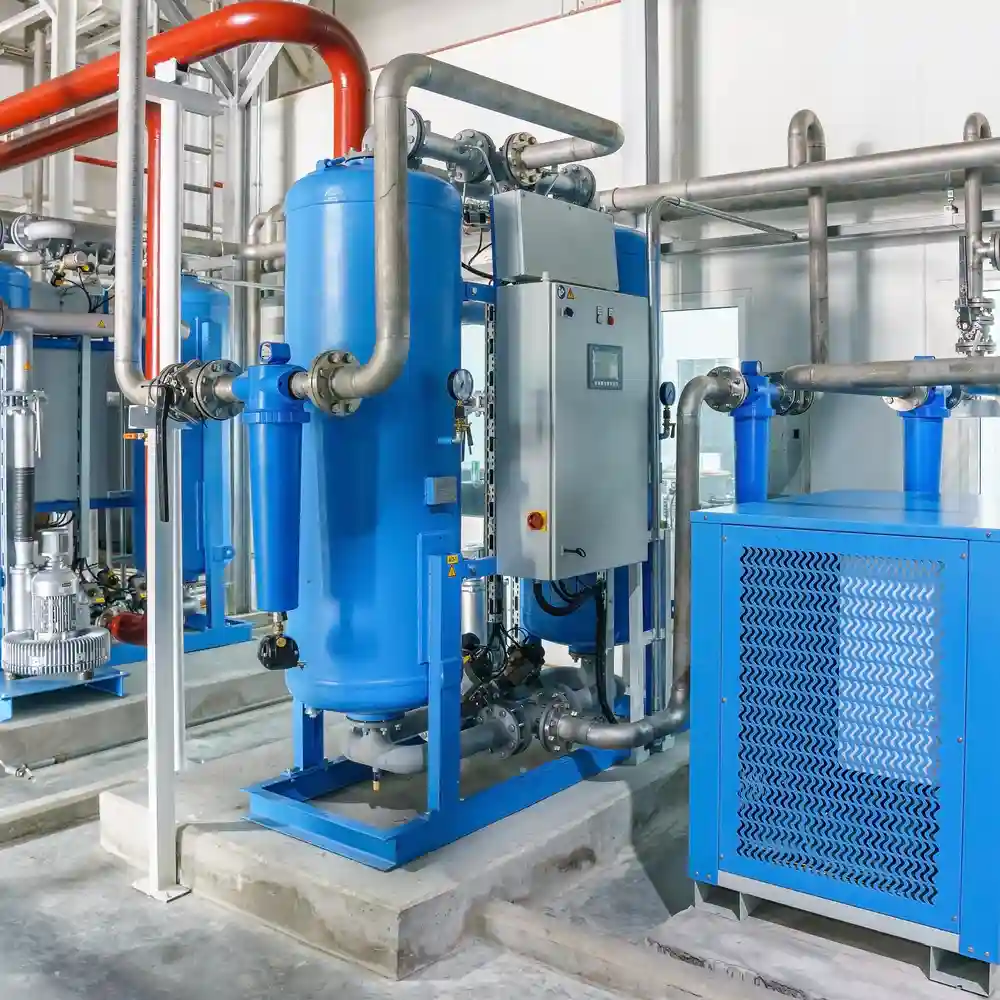
A laser cutter consumes a large, steady volume of nitrogen, so onsite pressure swing adsorption is usually the most practical and economical way to supply it. The method separates nitrogen straight from compressed air using selective adsorption on carbon molecular sieve.
Compressed air is passed through a vessel packed with CMS. The engineered pore structure of the sieve lets the smaller oxygen molecules enter the pores faster than the larger nitrogen molecules, so oxygen is held back while nitrogen passes through as product. The generator runs two or more vessels in an alternating cycle: while one vessel produces nitrogen under pressure, the other depressurises and vents the captured oxygen, which regenerates the sieve. That continuous swing gives a constant, on demand supply at the purity the laser requires.
Carbon Molecular Sieve and Generator Performance
The carbon molecular sieve is the core of the PSA generator, and its performance sets the purity, the flow rate and the running cost of the whole system.
- Purity. The pore size distribution of the sieve fixes how sharply it separates oxygen from nitrogen. A well made CMS with a tight pore distribution holds back oxygen more completely, so the generator can reach and hold higher purity. A poorly matched sieve caps the purity the system can ever deliver.
- Flow. The adsorption kinetics govern how fast the sieve captures oxygen, which sets the nitrogen flow available at a given purity. Faster kinetics let a smaller, more compact generator meet the same demand.
- Cost. An efficient sieve reaches the target purity and flow at lower pressure, so it draws less compressed air and less energy. Its working life also drives the total cost of ownership, since the sieve is a consumable that is topped up or replaced over time.
Matching the sieve to the duty is what lets a generator hold the purity a laser demands across the same range of industrial nitrogen applications Medaad serves, from cutting to inerting and blanketing.
Cylinder and Bulk Nitrogen versus Onsite Generation
For a long time the only ways to source nitrogen were high pressure cylinders or bulk liquid delivery. Both are simple to start with, but for a continuous, high consumption process such as laser cutting they carry ongoing cost and logistics. Cylinders bring rental, handling and repeated changeovers, while bulk liquid brings tank rental and evaporative loss between deliveries, and both leave the operation exposed to delivery schedules and gas price movements.
Onsite generation changes the model from a recurring gas bill to a predictable operating cost built mainly on electricity and sieve upkeep. The generator carries a higher initial outlay, but the cost per cubic metre of nitrogen falls well below delivered gas for a busy cutter, and the supply no longer depends on a delivery arriving on time. For a shop running one or more lasers through the day, that combination of lower unit cost and independence is the usual reason to generate on site.
Sieve Quality and Replacement Intervals
The sieve degrades if it meets liquid water, oil aerosols or fine particulate from a poorly maintained compressor, and it also loses a little capacity through normal cycling and bead attrition, so delivered purity drifts down slowly over the working life of a bed. As the pores foul, the generator struggles to hold purity, and the operator is forced to slow the cut to avoid oxidised edges, which quietly lowers throughput. Clean, dry inlet air and correct filtration ahead of the generator are what protect the bed.
Using carbon molecular sieve matched to onsite PSA nitrogen generation gives long service intervals and steady gas quality. Watching the pressure drop across the beds and the delivered purity shows when a refill or replacement is due, so a laser cutting line can plan sieve maintenance instead of losing cut quality without warning. Medaad supplies the grade and quantity of CMS a generator needs and advises on when to replenish it.
To size the right nitrogen supply for your laser cutting operation, send your material, thickness and target purity for a carbon molecular sieve recommendation, or reach the technical team through contact.
Contact Us Today